
UK Best Basketball Bets in 2026: A Data-Driven Guide for British Punters
 Available in US
The three numbers that define UK basketball betting in 2026
Basketball betting in the UK sits at the crossroads of three numbers that almost no affiliate guide bothers to put on the same page: a £16.8 billion gross gambling yield from the Gambling Commission's most recent industry report, more than 1.3 billion hours of NBA coverage watched globally last season, and a sport that just leapt seven positions in EY-Parthenon's UK Sports Engagement Index. That cluster of figures is the actual definition of the niche right now — a tightly regulated market, a global content firehose, and a domestic audience that has finally started caring.
I have been analysing basketball lines from a UK desk for eleven years. The first half of that career was spent explaining to friends why anyone would bet on a sport that finishes at 3 a.m. Sky Bet now treats EuroLeague like a midweek football coupon. Paddy Power has bet builders that nest player props inside team totals. The O2 Arena sold out 18,000 seats for Orlando Magic versus Memphis Grizzlies in January and pulled UK viewership 90% higher than the last London Game in 2019. The audience caught up with the product.
What you will not find here is a ranked list of "the best UK bookmakers" or a promo for any welcome offer. That is not how this market works in practice. What you will find: how the regulated UK market sets the rules every basketball wager must obey, which six market types matter and which exist purely to inflate margin, the maths that separates recreational stakes from a method, and how to read the regulatory turbulence that hit this market between the November 2025 Budget and the October 2025 NBA gambling indictments.
Two context blocks at the end cover NBA Europe, set to reshape UK basketball betting once it lands in October 2027, and the Rozier-Billups investigation, already reshaping how bookmakers manage prop liability.
On this page
- The three numbers that define UK basketball betting in 2026
- The UK market dashboard before you place a single bet
- The six markets that actually move the slate
- The honest selection criteria for a UK bookmaker
- Three leagues, three different bookmaking products
- Why basketball is the perfect live-betting product
- The two numbers that decide method versus habit
- The regulation shift that rewrote every UK basketball bet
- Why October 2027 already lives on the trading desks
- The Rozier-Billups indictments and UK prop markets
- What UK punters most often ask
- The state of UK basketball betting in 2026
What you'll learn in 90 seconds
- The UK gambling industry generated £16.8 billion in GGY in the year to March 2025, with the online segment up 13.1% and now accounting for 46% of total yield — basketball sits inside a regulated and expanding market.
- Six market types do roughly 95% of the work — moneyline, point spread, totals, player props, bet builders, futures — and they behave very differently across NBA, EuroLeague and Super League Basketball.
- UKGC licensing is the only honest filter when choosing a UK bookmaker for basketball, and from 31 October 2025 every licensed operator must offer financial limit setup before your first deposit.
- The maths threshold is 52.4% — the win rate you need to break even at -110 vig, against a Vegas spread error that has widened to 10.49 points in the modern era.
- Two stories define the 2025-26 backdrop: the Autumn Budget pushed Remote Gaming Duty from 21% to 40% for 2026, and the October 2025 NBA betting indictments forced bookmakers to retighten how they offer player props.
The UK market dashboard before you place a single bet
When I started covering this niche in 2015, the conversation about UK basketball betting fit on one page: NBA Finals outrights, the odd EuroBasket coupon, and a single Sky Bet desk that mostly thought about football. Eleven years later, the dashboard is unrecognisable. The UK is one of the most regulated gambling markets in the world, and basketball is the fastest-rising sport inside it.
£16.8 billion GGY
UK gambling industry, April 2024 to March 2025, up 7.3% year on year.
46% online share
Remote Casino, Betting and Bingo segment generated £7.8 billion, up 13.1%.
8,234 licensed premises
Down 1.1% year on year — the high street is contracting while online expands.
21% to 40% RGD
Remote Gaming Duty almost doubles in 2026; sports betting duty follows in 2027.
Each of those numbers shapes the basketball product you see on a Saturday night. A £16.8 billion industry can staff in-play trading rooms watching NBA half-time markets in real time. A 46% online share explains why every operator now leads with mobile and almost nobody markets the high street any more. The duty hike is already filtering down into the odds — operators do not absorb a near-doubling of remote gaming tax without tightening margins somewhere.
Where basketball fits in the UK gambling mix
Sports betting is the second-most popular gambling activity in the UK behind the National Lottery, with 10 to 12% of adults staking on it in any rolling four-week window. Basketball is a small slice of that volume — football still dominates UK sportsbook handle — but the slice is growing in a way no other minor-league sport is.
EY-Parthenon's UK Sports Engagement Index 2025 placed basketball at 13th overall after a seven-place jump in a single year. Among Gen-Z fans aged 18 to 24, the sport already sits 6th.
The EY-Parthenon team, announcing the Index, was unusually direct: "The standout growth story for the latest Index is Basketball, which jumped seven places to 13th, driven by younger fans engaging with the sport through social content and live events." The audience numbers match. The NBA's regular season pulled 170 million US viewers in 2025-26, up 86% year on year. Globally, NBA coverage cleared 1.3 billion hours, with the UK among the biggest English-language markets outside North America. Prime Video signed an 11-year broadcast partnership that started October 2025, UK explicitly included.
Who actually holds the UK basketball product
The household-name UK bookmakers all carry NBA, EuroLeague and Super League Basketball under their UKGC remote betting licences. Bet365's parent reported £3.8 billion in global sports and gaming revenue across the 2021-2025 window, making it the dominant trading desk by raw volume, but every UKGC-licensed operator from Paddy Power to Sky Bet to Betfair runs the same basketball menu. The differences live in prop depth, bet builder mechanics, and live-stream rights — not in whether NBA is offered at all.
The Betting and Gaming Council estimates 22.5 million British adults enjoy a bet each month. Basketball captures a sliver of that today, but the EY trajectory and Sport England's participation data — 1.55 million people in England played basketball in 2022-23, a record since 2015, and adult twice-monthly participation up roughly 50% since 2021 — tell a consistent story. The audience is widening, younger, and digitally native.
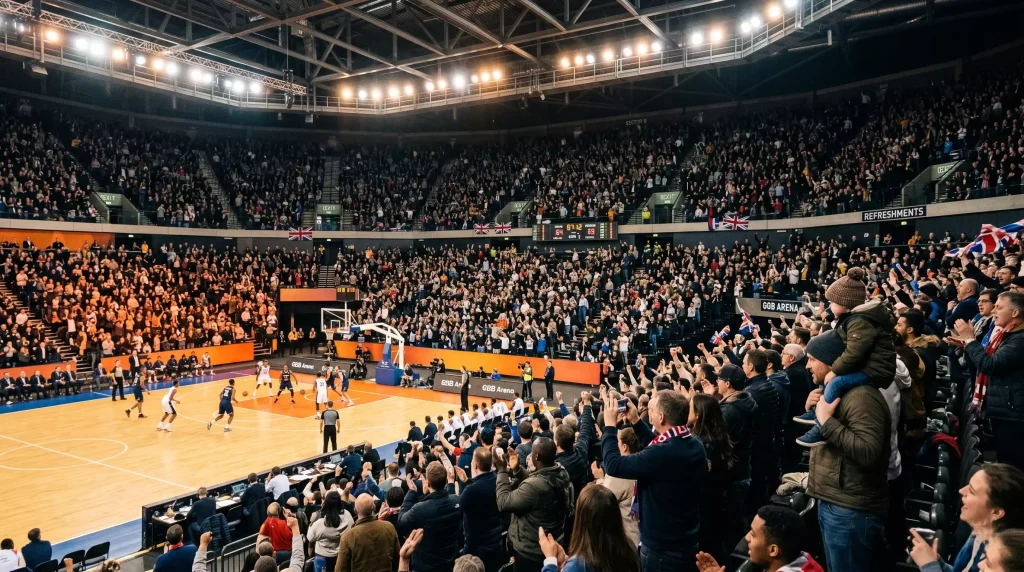
The six markets that actually move the slate
Open any major UK NBA coupon and you will see 200 to 350 markets per game. This is theatre. Of every 100 basketball bets struck through a UK sportsbook, my read of the trading reports suggests roughly 95 land in six market families. Everything else is liquidity-thin filler.
Moneyline
Straight pick of the winner. The cleanest market, with the tightest vig in NBA and the widest in SLB.
Point spread
Handicap line that levels the favourite. Standard NBA spreads run -8 to +8; EuroLeague hovers tighter.
Totals
Over or under the combined points. NBA totals sit in the low 220s in 2026; EuroLeague closer to 160.
Player props
Points, rebounds, assists, threes made, double-doubles. The deepest market in NBA, thinner everywhere else.
Bet builder
Same-game parlays combining team and player legs at correlated odds. The growth story of 2024-26.
Futures
NBA Finals winner, MVP, Conference outrights, NBA Cup. Long-dated, slow-moving, settled at season end.
Globally, basketball accounts for roughly 16% of the sports betting market by handle, and the standalone basketball betting market was valued near $8.7 billion in 2024 with projections towards $18.4 billion by 2033. NBA alone drives about 60% of that basketball share, which means UK-licensed sportsbooks are pricing the same product as Las Vegas, Sydney and Singapore desks. Most of the closing-line shift is driven by FanDuel and DraftKings — together roughly three-quarters of US handle.
One example to anchor the prices. Take a mid-November NBA game between two .500-record teams. Suppose the moneyline reads -135 home, +115 away, with a spread of home -3.5 at -110 each side. Translate that into decimal — favourites at 1.74 home, 2.15 away — and the implied probabilities sit at 57.4% and 46.5%. The overround is roughly 3.9%. On the spread side, a -110 line implies 52.4% on each leg — and that 52.4% is the single most important number in this guide.
Moneyline-to-implied-probability worked example
| Selection | Decimal | Implied probability |
|---|---|---|
| Home -3.5 | 1.91 | 52.4% |
| Away +3.5 | 1.91 | 52.4% |
| Combined overround | — | 104.8% |
The 4.8% overround is your cost of doing business. To beat the market over time you have to land above the implied probability by enough to absorb that vig on every settled bet.
How the six markets behave differently across leagues
Moneyline is cleanest in NBA because the sample size is huge — 1,230 regular-season games plus playoffs. Spreads work better in NBA than EuroLeague, where lower scoring tightens the margin of error. Totals are the most volatile NBA market right now: the league's three-point revolution means a single hot quarter can swing a 220.5 total by 8 to 12 points before half-time. Player props are where bookmakers have been most aggressive expanding inventory — and where, as I get to in the integrity section, they are also being most cautious in late 2025.
Bet builders sit in their own category. They are correlated parlays that let a punter combine "team to win" with "Luka Doncic over 27.5 points" and "total over 225.5" on a single ticket. The bookmaker prices the correlation, not the independent legs, which gives them margin control and the punter a single tappable narrative. They have exploded since 2023 and now drive a meaningful share of UK NBA handle. Futures behave like a different sport entirely — long-dated, slow-moving, best used as a small allocation.
The full mechanics — the alternative lines, the period markets, the race-to-N points, the buyout points on spreads — fill their own guide. I have written one. The deep dive on every basketball bet type, with real odds and league-by-league differences, sits in our complete breakdown of basketball betting markets.
The honest selection criteria the affiliate lists do not give you
Every affiliate "top 10 UK bookmakers" article I have read in the last five years answers the wrong question. The question is not which logo to click. The question is which features actually change the long-run outcome of your basketball bets, and which are window dressing. Three things matter, in this order: who holds the licence, what the operator's responsible-gambling architecture looks like, and how serious the basketball product is once you get past the welcome offer. Everything else — colour scheme, app speed, free-bet flair — is secondary.
| UKGC licence check | Limit and protection setup | Live-stream and trading depth |
|---|---|---|
| Verify the licensee on the UKGC public register before depositing. Operator brand names sometimes differ from the underlying licensed entity. Without a remote betting licence under Part 3 of the Gambling Act 2005, disputes — over overtime settlement, voided props, withheld winnings — are unenforceable from a UK address. | Confirm pre-deposit limit prompts work as the 31 October 2025 rules require. Six-month review reminders, integrated time-outs, one-click GamStop links and visible self-exclusion options are now baseline expectations. Basketball runs late and runs fast, and pre-set limits are the most reliable behavioural brake on a 2 a.m. tilt. | Test the NBA live feed on a midweek game before staking anything serious. Confirm EuroLeague and Super League Basketball stream rights, not just NBA. In-play prop depth, latency between event and price refresh, and bet-builder availability mid-game are the operator differentiators that compound across a season. |
The licensing question is not negotiable. Andrew Rhodes, the outgoing Gambling Commission chief executive whose tenure shaped the current rule set, framed his departure with this line: "It has been a privilege to lead the Gambling Commission through such an important period of change. I am proud of the progress we have made to strengthen regulation, improve consumer protections, and ensure gambling is safer and fairer." The licence is the consumer-protection layer that keeps your funds segregated and your disputes adjudicable. There is no equivalent if you bet offshore.
The limit architecture matters because the 31 October 2025 rule change reshaped how new accounts work. Every UKGC-licensed operator must now present financial limit options before your first deposit, with reminders every six months — the single biggest behavioural intervention in UK gambling regulation since GamStop, and now baked into every account opening flow.
Do
- Verify the licensee name on the UKGC public register before depositing — operator brands sometimes differ from the licensed entity behind them.
- Set a deposit limit at signup and review it every quarter, not every six months as the operator prompt suggests.
- Keep at least two licensed accounts so you can line-shop on the same NBA market when the prices diverge.
- Test the basketball stream on a free-to-watch midweek EuroLeague game before staking anything serious in-play.
- Read the void and overtime rules in the operator's basketball-specific terms and conditions, not the generic ones.
Don't
- Open an account with an unlicensed offshore site because the odds look 2 to 3% sharper. They are not your odds when the dispute breaks.
- Trust an "early payout" offer without reading the settlement clauses — what counts as a 20-point lead varies by operator and market.
- Treat welcome offers as a comparison axis. They are a marketing budget, not a product feature, and they reset to zero the moment you stake.
- Assume all operators settle player props identically. Overtime, fouled-out players and DNPs are handled differently across the book.
- Self-exclude only at the operator level when you need to step back — GamStop covers every UKGC-licensed online operator in a single action.
The deeper question — which UKGC-licensed sportsbook actually has the strongest basketball product in 2026 — is a longer audit. The detailed comparison, with the bookmaker interfaces, NBA market counts, and Super League Basketball rights mapped out, lives in our side-by-side review of the best basketball bookmakers in the UK.
Three leagues, three completely different bookmaking products
On a typical Tuesday in November I have three tabs open: an NBA evening coupon, the EuroLeague midweek round, and Super League Basketball for the domestic fixture. People assume they are interchangeable. They are not. The same market name behaves differently across all three.
The NBA is the dominant product. Roughly 60% of global basketball betting revenue runs through it, which means the lines are the sharpest, the markets the deepest, and the closing-line behaviour the most efficient of any league on the UK menu. EuroLeague is the European money market — lower scoring, tighter spreads, less prop inventory, but with the most attentive trading desks in continental Europe. Super League Basketball is the domestic story — fewer markets, thinner liquidity, and a UK-specific calendar that ties in with Basketball England's grassroots data.
| Attribute | NBA | EuroLeague | Super League Basketball |
|---|---|---|---|
| Games per week, regular season | 40 to 60 across the league; 6 to 12 per evening on the UK menu | 9 to 10 games per round, two rounds per week, across a 34-week regular season | 4 to 7 per round; ten teams; weekly cadence with cup interruptions |
| Live-stream availability | Most UKGC operators stream via a funded or free-to-play account; Prime Video carries marquee games on the 11-year UK deal launched October 2025 | Operator-dependent; selective coverage of marquee fixtures and playoff games rather than wall-to-wall | Sky Bet runs the deepest UK domestic coverage; most other operators offer pre-match only |
| Prop market depth | 30 to 50 player props per game, alternative lines on points and threes, full bet builder integration | 10 to 15 props per game; alt-totals limited; bet builder available on top fixtures only | Moneyline, spread, totals and basic player points; props deepening but still thin compared with NBA |
That table matters because it changes how you think about value. NBA market efficiency is so high that beating the closing line consistently is genuinely hard — the most rigorous open-source analysis of Vegas spread accuracy across 2006-2026, covering some 23,000 NBA games, shows the average miss has grown from 9.12 points in the traditional era to 10.49 in the modern variance era, but that variance is volume-correlated and washes out at scale. EuroLeague offers structural inefficiencies — late roster news, B-team rotations, travel windows — that disappear at the NBA level. Super League Basketball props are too thin to chase, but moneylines and totals sometimes lag the on-court reality around mid-season trades and import-player turnover.
The NBA Cup Semifinals in 2025 generated more than 400 million views across all platforms. The Emirates NBA Cup is now a fixture in UK winter betting coupons, with its own outright market and group-stage spread inventory that did not exist three seasons ago.
The Super League Basketball story everyone is missing
The British Basketball League ceased to exist in July 2024 when the British Basketball Federation pulled its licence. The successor competition, Super League Basketball, runs the domestic top tier from London Lions to Sheffield Sharks across an eight-to-ten team roster. The continuity is real — most clubs carried over — but the bookmaking product has been rebuilt from the ground up. UK punters who treated BBL as a curiosity now see SLB sit beside NBA on most coupons during the winter months.
The participation numbers explain the appetite. Around 1.55 million people in England played basketball in 2022-23, a record since Sport England's Active Lives Survey began in 2015. Roughly 344,400 adults play at least twice a month, up about 50% from 2021. Basketball England's youth participation has grown 65% since 2018. None of this directly moves a line, but it tells you why operators are investing in SLB markets that would have been laughed off five years ago.
The league-by-league deep dive, with fixture scouting, prop depth notes and scheduling tips, lives in our league-by-league breakdown of basketball betting in the UK.
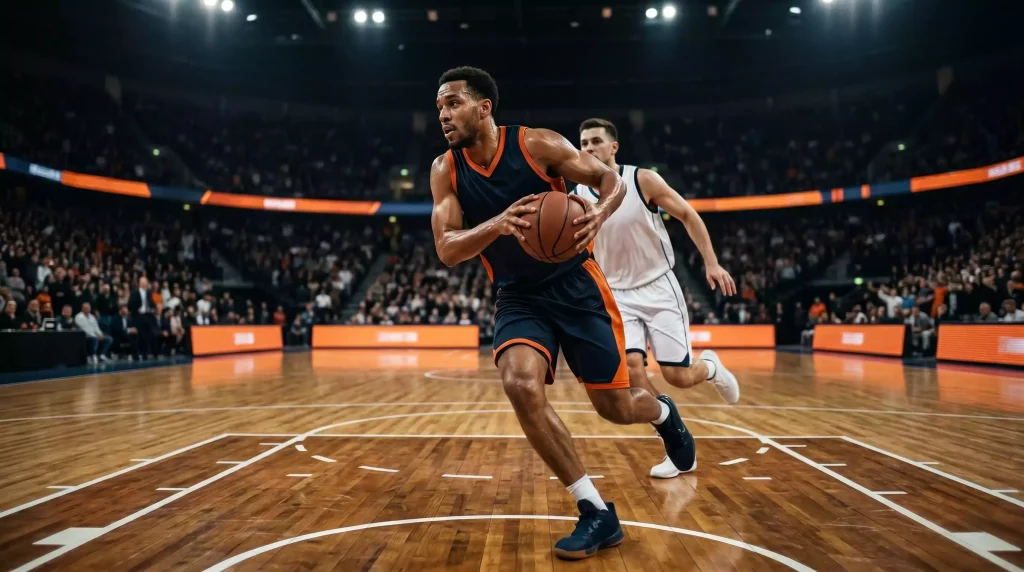
Why basketball is the perfect live-betting product
Of all the major sports on a UK coupon, basketball is the one engineered for in-play. No offside, no VAR pause, no batsman walking back to the pavilion. The possession clock resets in 24 seconds, two free throws take 20 seconds, and the line moves every time a shot drops. If pre-match betting is a chess match against the trader, in-play basketball is speed chess against an algorithm.
Live and in-play wagering captured 62.35% of online betting revenue globally in 2025. Mobile delivered 78% of all online sports bets in 2024. Basketball over-indexes on both, because the product is short, fast, and made for second-screen viewing.
I see this in my own staking pattern. Five years ago I would build a pre-match slip on a Saturday night and let it ride. Now I open a position before tip-off, sit through the first quarter, and reload conditionally based on the box score by the six-minute mark of the second. That is not strategy advice — it is just what the product invites.
The mechanics every UK punter should understand
Three features define a live-betting product worth using on basketball. The first is feed latency — the time between an event on court and the price refreshing on your screen. Most reputable UKGC operators run feeds that lag the broadcast by 3 to 8 seconds, and the broadcast itself lags the live event by 5 to 10 seconds. If your stream is on Prime Video and your sportsbook reads a direct data feed, the operator can be ahead of your eyes by ten or more seconds. Knowing your latency gap is the first piece of in-play hygiene.
The second is the cash-out function. Cash-out lets you settle a bet before the final whistle for a price the operator generates dynamically. The mechanics are not magic: the operator prices in their original margin plus a buffer. Used selectively, cash-out is a useful risk-management tool. Used impulsively in the fourth quarter, it is a margin-extraction lever pulled against you.
The early-payout angle worth knowing
Several UKGC-licensed operators pay out winning moneyline bets early if your team leads by 20 points at any stage of an NBA game. The mechanics differ — some require the lead to occur in the second half, some count any quarter, some apply only to pre-match bets, and many exclude the bet builder leg of any ticket that includes one. The headline offer is a marketing hook; the actual edge is in the small print. Read the early-payout clauses before you take the offer at face value.
The third feature is prop liquidity in-play. Pre-match player props get most of the marketing attention, but in-play prop trees — Luka Doncic next basket, total threes in this quarter, race to ten — are where bet builders and live bookmaking converge. The trading desks are good at this. They are not perfect. The window where they are weakest is the first ninety seconds after a starter exits with an injury, before the model has fully recalibrated to the new minutes distribution.
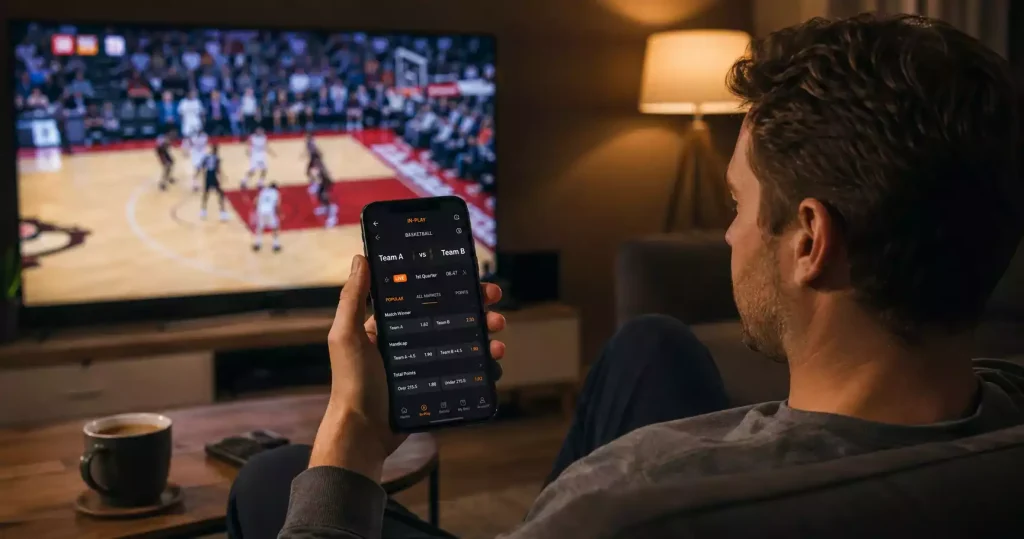
The deeper mechanics — full latency analysis, cash-out formulas, market-by-market in-play behaviour, and which features actually move the needle — sit in our complete guide to live NBA betting in the UK.
The two numbers that decide whether you have a method or a habit
If you read nothing else in this guide, read this. The difference between a basketball punter who breaks even over a year and one who slowly bleeds £1,500 a month is twenty basis points of win rate. Twenty. That is how thin the line is.
At standard -110 vigorish — the line every major UK operator quotes on NBA spreads and totals — the break-even win rate is 52.4%. Not 50%. The extra 2.4% is what the bookmaker is charging you for hosting the market. Below that win rate, you are slowly losing. Above it, you are slowly winning. Everything else in basketball betting strategy is secondary to that arithmetic.
How -110 vig produces the 52.4% break-even threshold
Place a £100 bet at -110 odds. The decimal price is 1.91. A winning bet returns £100 profit on £110 staked, net £91.
Lose the same bet, and you lose £100 in stake.
Over 100 bets, you need W wins and 100 minus W losses to break even:
91W minus 100 times the quantity 100 minus W equals zero.
91W minus 10,000 plus 100W equals zero.
191W equals 10,000.
W equals 52.36%, which rounds to 52.4%.
Win 52.4% of your spread bets at -110 and you break even. Win 53% and you make 1.1% return on staked turnover. Win 55% and you are at 5% ROI, which beats most professional sports traders over a full season.
The second number is closing-line value. CLV measures whether you beat the market price that exists at the moment the game starts. The closing line is the sharpest pricing available — the market's consensus view after all action has been booked. If you consistently bet earlier and at better odds than the closing line, you are extracting value before the market closes the gap. If your CLV is negative, you are paying the market for participation, and your long-run results will reflect that no matter how lucky a given week feels.
Vig — the bookmaker's margin built into a market's pricing. At -110 on each side of a spread, the vig is approximately 4.76% over the fair line, which is what produces the 52.4% break-even threshold.
Expected value, or +EV — the average return on a bet over infinite repetitions, calculated as the probability of winning times the winnings, minus the probability of losing times the stake. A +EV bet is one where your assessed probability beats the bookmaker's implied probability after vig.
Closing-line value — the difference between the odds you took and the final pre-game line. Positive CLV correlates with long-run profitability more reliably than any single bet's outcome, which is why serious punters track CLV obsessively and outcomes only secondarily.
What the modern variance era means for spreads
The most rigorous open-source analysis of NBA spread accuracy I have seen covers around 23,000 games from 2006 through 2026. The average absolute miss between the Vegas line and the final margin has grown from 9.12 points in the 2006-2016 traditional era to 10.49 points in the 2020-2026 modern variance era — a 15% widening of forecast error in a decade. The cause is no mystery. Three-point volume has roughly doubled, possessions are faster, and the variance in individual game outcomes has grown accordingly.
From a punter's perspective, this cuts both ways. Larger forecast errors mean more dispersion around the closing line — more opportunity if your model picks up on a structural inefficiency the market is slow to price, but more luck noise on a per-bet basis. You need a larger sample of bets before your win rate converges on your true edge.
None of this is novel — the maths has been the same since the 1980s. What has changed is the data infrastructure. Every play is logged. Every shot is location-tagged. Closing lines are queryable. The strategic deep dive — situational handicapping, back-to-back fade models, rest-advantage analysis, and the full CLV workflow — lives in our in-depth guide to NBA betting strategy in the UK.

The regulation shift that quietly rewrote every UK basketball bet
A friend who works on a UK bookmaker's trading desk described 2025 to me as "the year compliance ate the floor". She meant it literally. Every major operator now staffs more compliance and responsible-gambling roles than basketball traders. The 31 October 2025 financial-limits rule, the Budget duty hikes, and the long shadow of the Gambling Survey for Great Britain reshaped how every basketball bet on a UK coupon gets settled.
Start with the numbers. The Gambling Survey for Great Britain estimates 2.7% of UK adults score 8 or higher on the Problem Gambling Severity Index, with another 3.1% in the at-risk band and 8.8% in the low-risk band. Among 18-24 year olds, 21.9% register some PGSI score and 5.3% sit in the 8+ cluster — the highest rate of any age group. NHS England runs 15 specialist gambling treatment clinics across the country, and referrals more than doubled between 2023 and 2024, reaching 1,914 in the back half of last year alone. NICE published 2025 guidance that treats problem gambling as a mental-health concern, with formal screening recommendations in primary care.
The industry response to the November 2025 Budget was sharp. Grainne Hurst, chief executive of the Betting and Gaming Council, said in the post-Budget statement: "Massive tax increases for online betting and gaming announced in the Budget make them among the highest in the world, and are a devastating hammer blow to tens of thousands of people working in the industry across the UK, and millions of customers who enjoy a bet." EY modelling put nearly 15,000 high-technology jobs at risk and over £4 billion in stakes potentially migrating to unregulated operators.
The duty rise matters to basketball punters for one practical reason. Operators do not absorb a 21-to-40% Remote Gaming Duty increase in 2026 without quietly tightening margins. The first place that shows up is the prop market. Expect tighter alt-totals, narrower spreads on player points, and lower payouts on bet builders by the spring of 2026. The headline odds will look similar; the implied probabilities will not.
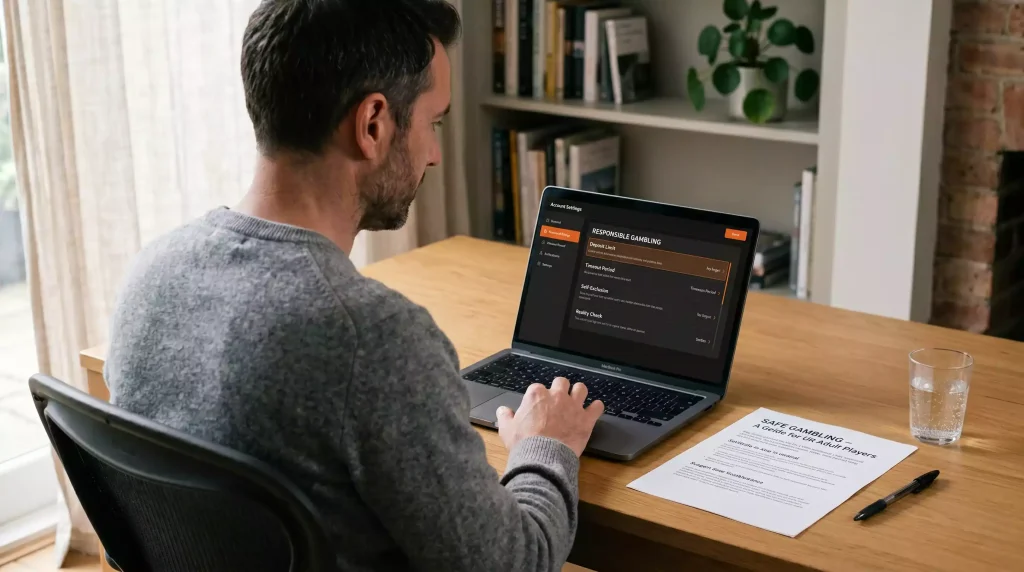
What the 2025 reforms actually changed for an individual is the friction structure of an account. Five tools matter, in the order you should set them up.
The five-step responsible-gambling setup every UK basketball account should have
- Set a deposit limit at account opening, mandatory since 31 October 2025 — and review it every quarter, not every six months as the operator prompts.
- Configure a time-out before your first deposit — most UKGC operators allow blocks of 24 hours, 7 days, 30 days or 6 weeks at your choice.
- Register with GamStop if you need a national-level exclusion — one action excludes you from every UKGC-licensed online operator simultaneously.
- Use operator-level self-exclusion for shorter-term breaks tied to a single brand, with periods running from 6 months to 5 years.
- Know where the nearest NHS specialist gambling clinic is — there are 15 across England, and referrals are GP-initiated or self-initiated.
None of these tools are punishments. They are guardrails the regulator and the industry now treat as the baseline of a healthy account. The single biggest mistake I see UK punters make in 2026 is treating the limit setup as a hoop to jump through rather than as the most useful behavioural tool in the regulatory toolkit. Set it tighter than you think you need. You can always raise it, and the friction of raising it is exactly what the system is designed for.
Why October 2027 already lives on the trading desks
I keep a calendar reminder dated 1 October 2027. That is the target launch month for NBA Europe, the joint venture between the NBA and FIBA that has been measured "in years, not months" since it was first floated publicly. London is one of the named candidates for a founding franchise. Entry fees, per the public reporting, sit between $500 million and $1 billion. Adam Silver and the NBA leadership have already met with Prime Minister Keir Starmer and London mayor Sadiq Khan on the question of London participation.
You do not need to care about franchise mechanics to care about this. What matters for UK basketball betting is the audience effect. The NBA London Game in January 2026 — Orlando Magic versus Memphis Grizzlies at the O2 — pulled UK viewership 90% higher than the last London fixture in 2019, with 18,000 in arena. The 11-year Prime Video broadcast partnership launched October 2025 has already raised UK exposure to the regular season. EY-Parthenon's engagement index puts basketball at 13th overall and 6th among 18-24s. NBA Europe lands on top of a UK audience pre-conditioned for it.
What the league principals have said publicly
Adam Silver, in his 2026 All-Star Saturday address: "You have amazing basketball right now in Europe, historic clubs competing at a high level. How we launch the league might not look how it will several years later. One of the things we're focused on is building a new arena infrastructure in Europe, as well, which is badly needed." The commercial framing from his Paris Games press conference earlier in 2025 was more direct: "We are looking very closely to see if there's an opportunity to professionalize the game to another level here, to create a larger commercial opportunity."
The trading-desk implication is straightforward. A London-franchised NBA Europe team would push UK basketball handle materially higher within two seasons of launch. The bookmaking product will deepen, the prop inventory will expand, and the market will move from "minor sport with a US-import audience" to "tier-two domestic product" almost overnight. Whatever you bet on basketball today, the architecture you build now is the architecture you carry into that shift.
The Rozier-Billups indictments and what they mean for UK prop markets
October 2025 produced a story that took every prop trader I work with by surprise. The U.S. Attorney's office in the Eastern District of New York announced more than 14 indictments tied to what it described as a mafia-backed sports betting and rigged-poker operation. The named defendants included Miami Heat guard Terry Rozier, Portland Trail Blazers head coach Chauncey Billups and former player Damon Jones. The reporting described more than $200,000 in "under" prop bets on Rozier's performance across seven NBA matches.
The U.S. Attorney's framing in the FBI press conference was unsparing: "The mafia … had preexisting control over non-rigged, illegal poker games around New York City." The investigation as filed is about how that infrastructure layered organised betting fraud on top of the existing poker operation. The mechanics — early exits, suspicious volume on obscure under-points lines, social-engineering of insider information — match a pattern integrity firms have flagged for two years.
Why this is in a UK pillar guide
The U.S. now has legal sports betting in 39 states plus the District of Columbia, and the NBA holds official partnerships with both DraftKings and FanDuel. When an integrity incident hits the U.S. wholesale market, the line moves are visible in real time on UK coupons, because the same data feeds price the same markets. Every UKGC-licensed operator running NBA props in November 2025 discreetly tightened their player-points liability, reduced alt-totals depth, and added human review gates to bet-builder legs that combined player-unders. None of these changes were announced. All of them are visible if you have been tracking the pricing closely.
What this should change for a UK punter is the diligence layer on player props, not your willingness to play them. The vast majority of NBA prop markets remain efficient and clean. But the specific intersection — player-unders, low-minutes role players, obscure alternative lines — now carries an additional layer of integrity risk that the trading desks are pricing for. If you see a sharp move on an under-points prop with no apparent injury news, the desk is hedging against the same risk the FBI is investigating.
The broader regulatory implication will land through 2026 and 2027. Expect tighter restrictions on prop bet inventory in markets where the integrity-to-volume ratio looks weak. The UKGC has not commented publicly as I write this, but the conversation inside the industry is happening.
What UK punters most often ask about basketball betting
What are the most popular basketball betting markets in the UK?
Six markets account for roughly 95% of UK basketball handle: moneyline, a straight winner pick; point spread, which handicaps the favourite; totals, the combined points over or under; player props, covering points, rebounds, assists, threes and double-doubles; bet builders, which are correlated same-game parlays; and futures, including Finals winner, MVP and NBA Cup outrights. Moneyline and spreads dominate pre-match volume; player props and bet builders drive the in-play share, which has grown sharply since 2023. Everything else — period markets, alternative lines, race-to bets — is thinner inventory designed to fill the page rather than drive volume.
Is basketball betting legal in the UK?
Yes, basketball betting is legal in the UK when placed with a UKGC-licensed operator, under Part 3 of the Gambling Act 2005. The legal threshold is 18 years old. The licensed market covers NBA, EuroLeague, Super League Basketball, NCAA, FIBA tournaments and the NBA Cup. Offshore unlicensed operators may accept UK customers, but you forfeit the Gambling Commission's consumer protection — segregated funds, dispute adjudication, mandatory limits, GamStop integration — when you bet outside the licensed market. The licence is the consumer-protection layer that makes your funds and your disputes enforceable from a UK address.
How do UK punters read basketball point spread lines?
A point spread is the bookmaker's handicap on the favourite. If you see Boston Celtics -7.5 at -110, the Celtics must win by 8 or more for the bet to settle as a winner. The opposing side at +7.5 means the underdog can lose by up to 7 and still cover. The -110 price is the vig — at decimal 1.91, that translates to a 52.4% break-even win rate. The half-point hook at 7.5 prevents a push tie. Spreads tighten in EuroLeague and Super League Basketball, because lower scoring compresses the margin of expected outcomes around the line.
Why are bet settlement rules different across NBA markets?
Settlement rules differ because each market has its own contractual definition of completion. Most moneyline and spread markets include overtime by default — the result that stands is the final score after any OT. Player props vary: some operators include OT minutes and stats, others settle on regulation time only, and the difference can swing whether your over 25.5 points prop cashes. Period markets like first-half and third-quarter bets do not include OT regardless of operator. Always check the basketball-specific terms, not the generic ones. Variance between operators is real and unannounced.
How do bet builders work for NBA?
A bet builder combines multiple selections within a single NBA game into one priced ticket. Typical legs include team to win, total over or under, individual player points, threes made, and double-doubles. Unlike a traditional accumulator, where each leg's odds multiply independently, bet-builder pricing accounts for correlation — a Lakers to win leg and a LeBron James over 25.5 points leg are not statistically independent, and the operator's pricing model reflects that. The advantage is a single tappable narrative across one game; the trade-off is that the operator controls the correlation model, which gives them margin flexibility you cannot fully see.
What's the difference between EuroLeague and NBA betting in the UK?
NBA betting is the deepest market on a UK coupon — more games, more props, more bet builders, and the sharpest pricing because the global handle is largest. EuroLeague runs as a 34-week regular season with around 9 to 10 games per round and two rounds a week. Pricing is sharper for spreads because European teams play with more defensive structure and lower variance. Prop inventory is thinner — typically 10 to 15 player props per game versus 30 to 50 in NBA. The structural value in EuroLeague tends to live in late roster news, B-team rotations, and travel-related rest dynamics.
How do UK bookmakers handle responsible gambling on basketball?
Every UKGC-licensed operator follows the same regulatory framework regardless of sport. The key 2025 changes: mandatory financial-limit prompts before first deposit since 31 October, six-month review reminders, integrated time-out tools, single-action GamStop registration that excludes from all UKGC operators at once, and links to NHS specialist clinics. Basketball-specific risk factors — late-night NBA tip-offs, fast in-play markets, prop bet density — make pre-set limits more important than for football. The 15 NHS gambling clinics across England saw use rise 130% over the previous year, and the architecture exists precisely because the sport's pace invites the kind of tilt that limits are designed to interrupt.
The state of UK basketball betting in 2026 and the questions still open
If you have read this far, you have more context on UK basketball betting than 95% of the UK punters who will place an NBA bet tonight. You know the market sits inside a £16.8 billion regulated industry, that six market types do almost all the work, that 52.4% is the break-even line every staking decision lives or dies by, and that the regulatory architecture changed materially in the autumn of 2025.
The honest answer about what comes next is that 2026 is a transition year. Remote Gaming Duty almost doubles. NBA Europe sits in a press-release holding pattern. The Rozier-Billups indictments are still working through the U.S. courts. The Gambling Commission is mid-cycle on the Statutory Levy roll-out. Super League Basketball is in its second post-BBL season and the bookmaking product is still maturing. Nothing about UK basketball betting in 2026 is settled.
What does not change is the underlying discipline. Pick a UKGC-licensed operator. Set your limits before your first deposit. Understand the markets you are betting on, not the marketing wrapped around them. Track your closing-line value, not your individual-bet outcomes.
The eleven years I have spent on this niche have taught me one durable lesson. The punters who survive long enough to have a multi-year track record are the ones who treated the maths as non-negotiable from the first £20 stake. Everything else — the brand selection, the welcome offer, the prop strategy, the integrity headlines — is downstream of whether you respected the 52.4% line.
Recommend
Prepared by the Best Basketball Bets editorial staff.
